

Jev Agent
Free access to TypeSafe’s Jev System One via a live API key — demos, measured costs, independent writeups. Unofficial, not affiliated with TypeSafe.
DR:DR 27(Domain Rating by Ahrefs)
Added on:Nov 05, 2026
Pricing:Freemium
What is Jev Agent?
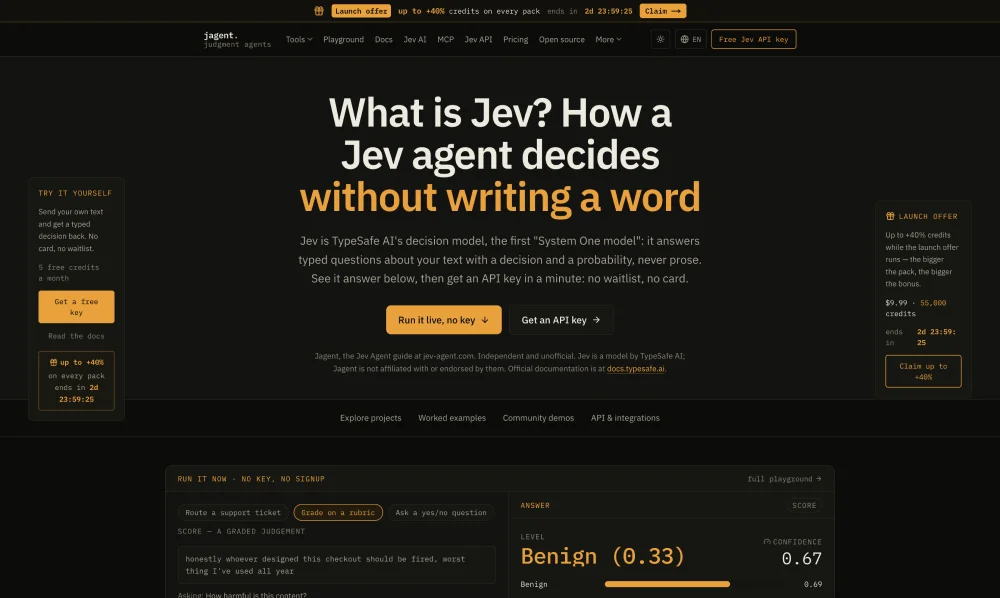
Jev Agent is an independent, unofficial resource for developers who want to understand and build with Jev, the decision model created by TypeSafe AI. Rather than acting like a conventional chatbot, Jev evaluates text against structured questions and returns machine-readable decisions, scores, probabilities, and confidence values. Jev Agent explains this approach through practical examples, interactive demos, technical guides, and access to browser-based tools. At the center of Jev Agent is a live playground where visitors can test decisions without creating an account. Developers can submit text and experiment with three core decision types: Choice selects an option from a defined set, Score evaluates content against a custom rubric, and Noul estimates whether a statement is true or false. Multiple questions can be sent together, allowing a single request to support tasks such as support ticket routing, content moderation, lead qualification, phishing detection, and AI model selection. Jev Agent also provides API documentation, sample requests, integration guidance, and a directory of community projects. Developers can connect Jev to existing applications through HTTP APIs, Python and TypeScript SDKs, or remote MCP integrations for tools such as Claude Code and Cursor. Jev Agent includes examples for combining Jev's structured judgments with conventional language models, where Jev makes bounded decisions and another model handles explanations or generated content. Beyond developer resources, Jev Agent offers browser-based utilities such as AI resume checking, essay grading, teacher grading, and rubric generation. Jev Agent's tools apply defined criteria and present scores with probabilities, helping users inspect how each assessment was reached. With Jev Agent, users can start with a small monthly free credit allowance, test the service, and purchase additional one-time credit packs when needed. Overall, Jev Agent serves as a practical learning and access hub for applying fast, structured AI decisions to software workflows, evaluation tasks, and agent systems.
Key features of Jev Agent
- Live playground for text decisions
- Choice, Score, and Noul evaluations
- API guides with code examples
- Remote MCP and SDK integrations
- Browser-based resume and essay graders
- Free monthly credits, one-time purchases
- Community projects and practical workflows